Right, here we are. Indoor season (in the north hemisphere at least!) and I've come through the winter uninjured, and with reasonable mileage under my belt. I'm really enjoying my training with my coach Jon Tilt (World Masters M55 400m Champion, World Masters M55 400mH Champion, and World Masters M55 4x400m Champion), and I've allowed myself to start layering on a bit of speed to take me into the indoor races. And (without film evidence to back it up) I do believe that the new gait is better embedded and well on the way to being subconscious.
So, three and a half years after starting the gait change journey (has it REALLY been that long?!) I now find it completely natural to land under the hips. I do constantly do a round-check of my proprioceptive cues, and usually everything below the waist is in order!! However, I know that I still need to work on my core, as I often catch my back bent, and my arms pulled up and crossing my chest. A quick "Keith's Game Changer" drill (well, the second part of it - whilst on the move) sorts it out, but it's annoying that it keeps happening. I did hear the great coach Rod Lock shout, exasperatingly, at one of his athletes (it wasn't the Great British international Alex Teuten by the way) "how hard is it to keep your arms at 90 degrees!!!", and I replay that sound bite to myself when I catch my arms up at my chest. Unfortunately, I catch them up there all to often.
Anyway, back to the track races. I don't quite remember the point at which, in January, the motivation to enter a few indoor races kicked in. I'm not a great fan of indoor tracks - only 200m and banked. The 800m is 4 laps, and without any sense of sarcasm in my words, on the 2nd and 3rd lap I sort of lose track of where I am. Outdoors is easy. If you haven't heard the bell yet: you're on the first lap! Indoors, that second and third lap blend into one, and it takes conscious thought to gauge how much energy there is left for the remainder of the race. I know that practice would help, but when the closest indoor track is 101 miles away in north London (including a semi circumnavigation of the dreaded M25), it's not going to happen often.
I actually think that the motivation to do some indoor races came from missing most of the t&f season last summer, as well as the desire to see the inside of more indoor arenas than just that Lee Valley centre in North London. Also, the prospect of a couple of days out with mates is also appealing.
So with that motivation in one back pocket, and the training in the other, I went to the Welsh Masters' indoor t&f championships in Cardiff late Jan with Jim Bennet, and the Sheffield Masters' and Open Grand Prix early Feb, with Jon Tilt and Del & Jackie Warn (huge thanks to Del for taking on the 8 hours of driving that day!)
The result? Well, Cardiff threw up a bit of a shock! I guess it was my first properly competitive, properly prepared 800m race since March 2018, and it was a slightly tactical heat with a few elbows (the most enjoyable form of 800m racing!), but a 2:12.10 was alarmingly slow. The only saving grace was that I finished with absolutely no lactic, so I knew there would be better to come.
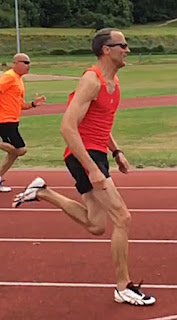
Sheffield was a different kettle of fish. I was in a heat with some younger masters, and it was much more of a time trial. Friend Peter Watkeys of Basingstoke and Mid Hants AC pulled the group round, and there was no need for wide bends or overtaking maneuvers, so I ended up with a very pleasing 2:08.56 - less than a second away from my indoor personal best. Thanks to Jon Tilt for this footage (missing the last 50m, but good close up footage for each of the 4 "fly-bys"!)
That's all for now. Thanks to the OYF Running Group on facebook for the inspiration to get back to this blog.
Thursday, 14 February 2019

Friday, 26 October 2018
To Celebrate the publication of Keith and Heidi's new book....
...well, officially it's the second edition of the brilliant Older Yet Faster. And although the foundation on technique and the potential outcomes are the same, the book is so new, and so significantly updated, that in my humble opinion, it's basically new!! Congratulations to Keith and Heidi, I hope this is as successful as it deserves to be.

I see it's out in print and on Kindle from Amazon in the UK.
On the running front, I made a bit of a mistake way back in April. Elated at my 800m indoor personal best, and feeling invincible, I went straight into summer speed training with my training family (the Jon Tilt 400m group here at Southampton AC). This led to a 4:49 mile at the British Master's Championship at the end of May: a silver medal to another Adrian Haines victory.
However, it turns out I was not invincible. Who knew? The lack of a spring season tempo run build up, progressing straight from slow winter base miles into summer speed, put incredible pressure on my ageing ligaments, and I hobbled away from that mile race.
I stuck on a vest and shorts, and enjoyed the long, hot summer we had in the UK this year.
Fast forward to last weekend, and following some good miles in August and September, but not much speed work again yet, I managed a 60:28 at the Great South Run. My aim of starting the Winter base phase in good shape, AND IN GOOD FORM, is in the bag...

...well, officially it's the second edition of the brilliant Older Yet Faster. And although the foundation on technique and the potential outcomes are the same, the book is so new, and so significantly updated, that in my humble opinion, it's basically new!! Congratulations to Keith and Heidi, I hope this is as successful as it deserves to be.

I see it's out in print and on Kindle from Amazon in the UK.
On the running front, I made a bit of a mistake way back in April. Elated at my 800m indoor personal best, and feeling invincible, I went straight into summer speed training with my training family (the Jon Tilt 400m group here at Southampton AC). This led to a 4:49 mile at the British Master's Championship at the end of May: a silver medal to another Adrian Haines victory.
However, it turns out I was not invincible. Who knew? The lack of a spring season tempo run build up, progressing straight from slow winter base miles into summer speed, put incredible pressure on my ageing ligaments, and I hobbled away from that mile race.
I stuck on a vest and shorts, and enjoyed the long, hot summer we had in the UK this year.
Fast forward to last weekend, and following some good miles in August and September, but not much speed work again yet, I managed a 60:28 at the Great South Run. My aim of starting the Winter base phase in good shape, AND IN GOOD FORM, is in the bag...

Monday, 9 April 2018
Ugh, work just gets in the way of running!
Well, to be more accurate, gets in the way of writing about running... sorry about that.
I was always skeptical that I could break any personal bests at 51 years old, and 10 years after getting into middle distance running in a serious way. But Keith insisted that it would happen, and was confident enough to assert that "if you don't, you'll be the first"!
So 8 weeks ago, at the British Master's Athletic Federation indoor t&f championship, I broke my all time indoor 800m time, with a 2:07.64. I've had a number of 2:08's before, but this is the first time I've gone under that mark. And I don't even like the indoors!
That time was not good enough to take the MV50 title like I had done last year. But it was a much more rewarding race in that I had friends Adrian Haines and Gary Burnett, and the brilliant newcomer Dominic Bokor-Ingram to race with this year. We all finished within 2.5s of Adrian's 2:05.08, and I just managed to hold off Gary for the bronze.

Roll on the summer!
Well, to be more accurate, gets in the way of writing about running... sorry about that.
I was always skeptical that I could break any personal bests at 51 years old, and 10 years after getting into middle distance running in a serious way. But Keith insisted that it would happen, and was confident enough to assert that "if you don't, you'll be the first"!
So 8 weeks ago, at the British Master's Athletic Federation indoor t&f championship, I broke my all time indoor 800m time, with a 2:07.64. I've had a number of 2:08's before, but this is the first time I've gone under that mark. And I don't even like the indoors!
That time was not good enough to take the MV50 title like I had done last year. But it was a much more rewarding race in that I had friends Adrian Haines and Gary Burnett, and the brilliant newcomer Dominic Bokor-Ingram to race with this year. We all finished within 2.5s of Adrian's 2:05.08, and I just managed to hold off Gary for the bronze.

Roll on the summer!
Tuesday, 17 October 2017
One on marathon nutrition
As a bit of winter base training, and just for fun, I ran the Bournemouth marathon last weekend. I wasn't aiming at a time, just to enjoy the run, take advantage of the water stops, and to be part of a big event.
Coming out the other side, there were actually some learning points. But first....
A quick word on gait - now that I'm not ramming my heels into the tarmac 40,000 times in 3.5 hours, I found that I recovered incredibly quickly. I can't believe how little damage I did to my legs. I was waiting for DOMS for the next 48 hours, but it never came. So 54 hours after hitting the finish line in Bournemouth, I was running in the club's Tuesday evening 6x800m off 60s session. Sure, I ran the first efforts easy in case something broke, but the last two efforts I was hitting sub 2:50 which is up with my best for this session!
Anyway, this post is more about the nutrition learnings.
The following graph shows heart rate, but I also selected elevation (the thin green line) as it explains some of the heart rate variations.
The very flat sea-level sections represent the flat seaside promenade on Boscombe, Bournemouth and Poole seafronts. The black line is heart rate.
Click on the graph for a full size version!

In terms of effort, that first 4k felt very easy. I was letting people pass me (and I had started in the third pen back), I was chatting, and I hit 4:50/km on average.
Then as you can see, there was a downhill section at 4km, that flattened out. I suspect that the pace and cadence increased, because as the downhill flattens out, you can see that the heart rate raises as I must have tried to maintain the faster pace (the red box). Certainly I was now overtaking people. I remember looking at my watch at about 10k and seeing that the average pace had come down to 4:41/km. From 5km to 21km the heart rate is higher, and as I would soon find out, above the fat burning zone!!
From half way, I was in trouble! 10 miles of burning glycogen had left me depleted. I took a couple of gels from the feed stations (I think about half way and again at about 30 km). At 30km I thought I was going to have real trouble finishing. Walking the two hills had taken their hit on the average pace, and I was down at 4:57/km.
[At this point, I have to confess that in general my HCLF regime is not going as well as it was this time last year (Healthy Fat Low Carb). It's hard work! Autumn 2016 I was frying vegetables and pork belly, I was avoiding all rice and pasta, I was only having one roast potato with Sunday Lunch. OK so I haven't gone back to the muffins 3 or 4 times a week, and I never buy chocolate bars now, so sugar intake is still way down. But I've slipped out of my most efficient fat burning abilities that I enjoyed at the Portsmouth Marathon last December.]
Back to the Bournemouth Marathon. 30km. You can see that the heart rate comes back down (the green box). And this is where I start to recover. I remember, from the 6 marathons I did between 2001 and 2006, when I hit the wall, I REALLY hit the wall. Half Foster territory. Once in London, I had to walk from Tower Bridge to Canary Wharf. But not at Bournemouth last weekend. The wall never came, I think it was about half a mile down the road the whole last half.
This time, I believe I had enough retained ability to metabolise fat that I experienced a bit of a recovery, and the pace never dipped slower than 4:57/km.
Going through the 24mile marker, I realised I had 19 mins left to get under 3:30, and I thought "what the hell". So for the last 2.2 miles I really picked up the pace, bringing the agerage back down to 4:56/km. I hit the finish in 2:29:50!! Boston Qualifier by 10 seconds!
So, although the highest heart rate at which I can run on fat alone has probably come down a bit, the ability is still there.
Not exactly scientific, but I am still enjoying this experiment with a sample size of 1....
Coming out the other side, there were actually some learning points. But first....
A quick word on gait - now that I'm not ramming my heels into the tarmac 40,000 times in 3.5 hours, I found that I recovered incredibly quickly. I can't believe how little damage I did to my legs. I was waiting for DOMS for the next 48 hours, but it never came. So 54 hours after hitting the finish line in Bournemouth, I was running in the club's Tuesday evening 6x800m off 60s session. Sure, I ran the first efforts easy in case something broke, but the last two efforts I was hitting sub 2:50 which is up with my best for this session!
Anyway, this post is more about the nutrition learnings.
The following graph shows heart rate, but I also selected elevation (the thin green line) as it explains some of the heart rate variations.
The very flat sea-level sections represent the flat seaside promenade on Boscombe, Bournemouth and Poole seafronts. The black line is heart rate.
Click on the graph for a full size version!

In terms of effort, that first 4k felt very easy. I was letting people pass me (and I had started in the third pen back), I was chatting, and I hit 4:50/km on average.
Then as you can see, there was a downhill section at 4km, that flattened out. I suspect that the pace and cadence increased, because as the downhill flattens out, you can see that the heart rate raises as I must have tried to maintain the faster pace (the red box). Certainly I was now overtaking people. I remember looking at my watch at about 10k and seeing that the average pace had come down to 4:41/km. From 5km to 21km the heart rate is higher, and as I would soon find out, above the fat burning zone!!
From half way, I was in trouble! 10 miles of burning glycogen had left me depleted. I took a couple of gels from the feed stations (I think about half way and again at about 30 km). At 30km I thought I was going to have real trouble finishing. Walking the two hills had taken their hit on the average pace, and I was down at 4:57/km.
[At this point, I have to confess that in general my HCLF regime is not going as well as it was this time last year (Healthy Fat Low Carb). It's hard work! Autumn 2016 I was frying vegetables and pork belly, I was avoiding all rice and pasta, I was only having one roast potato with Sunday Lunch. OK so I haven't gone back to the muffins 3 or 4 times a week, and I never buy chocolate bars now, so sugar intake is still way down. But I've slipped out of my most efficient fat burning abilities that I enjoyed at the Portsmouth Marathon last December.]
Back to the Bournemouth Marathon. 30km. You can see that the heart rate comes back down (the green box). And this is where I start to recover. I remember, from the 6 marathons I did between 2001 and 2006, when I hit the wall, I REALLY hit the wall. Half Foster territory. Once in London, I had to walk from Tower Bridge to Canary Wharf. But not at Bournemouth last weekend. The wall never came, I think it was about half a mile down the road the whole last half.
This time, I believe I had enough retained ability to metabolise fat that I experienced a bit of a recovery, and the pace never dipped slower than 4:57/km.
Going through the 24mile marker, I realised I had 19 mins left to get under 3:30, and I thought "what the hell". So for the last 2.2 miles I really picked up the pace, bringing the agerage back down to 4:56/km. I hit the finish in 2:29:50!! Boston Qualifier by 10 seconds!
So, although the highest heart rate at which I can run on fat alone has probably come down a bit, the ability is still there.
Not exactly scientific, but I am still enjoying this experiment with a sample size of 1....
Thursday, 12 October 2017
Keith and Heidi come to town!
Two months on, and I still cannot believe how lucky we were to have Heidi Jones and Keith Bateman visit us at the Southampton Sports Centre in July 2017! Heidi and Keith were over in the UK visiting family, and enjoying the New Forest, and for us it was an opportunity too good to miss.
A group of 20 of us, from as far afield as Watford (Adrian Harwood), Bristol (Susie Baker) and Crawley (Adrian Haines), were split into two, taking it in turns to do a gait session with Keith, and a foot strength session with Heidi.

The sessions gave us all something personal to take away. Some of us are new to the techniques, to the drills, and to the joys of the spiky massage ball! Others have read the book (in some cases multiple times) and are practiced, filmed, and well on the way on our journeys.

We spent almost an hour on each session, but personally, I could have easily spent two or three. I get the impression that Keith would be happy to talk, advise, and coach for even longer than that!! To say that these two are passionate about their disciplines would be a gross understatement, and it's infectious...
As I always say about teaching sessions like this, as long as you go away with at least one nugget, it's been a success. I took away many, and here are the best two examples:
- During Keith's session, as we were practicing technique on the track, Keith noticed that I was lifting my knees too much (for the pace involved), and I have managed to correct that since on my slower/recovery runs.
- When Heidi asked if there were any particular points anyone would like to raise, I complained of ongoing dull ache in the Achilles. Heidi demonstrated an exercise that, with very few exceptions, I've employed to excellent effect every evening since. Heidi claimed the effects would be felt immediately, and she was right. I've tried to describe the exercise at the bottom of this post.
Anyway, we all had a fantastic evening, made some new friends, and left with much to think about. And we sent Heidi and Keith away with a couple of decent bottles of English (Kent) wines as a small redress of the balance of Australian wine that reaches our shores! And again, a HUGE thanks to Heidi and Keith.
Heidi's Achilles "Fixer" Exercise
This exercise will not only strengthen Achilles, but provide almost immediate relief from Achilles ache, which feels strange at first as most of us resort to actually stretching them to get relief, not shortening them! But it worked for me and continues to do so.
- Take your shoes and socks off
- Stand facing the back of a chair, or something that you can hold on to for stability. A wall is works as it is to stop you falling forward or back, that's all (we used those railings in the second picture above)
- reset your stopwatch, or at least have sight of a watch with seconds showing
- with straight legs, raise up on to your toes. Don't strain, but raise as high as you can hold for 45 seconds.
- after 45 seconds, keep the feet as they are, but bend your knees. Again, not so far that you're having to work hard to hold the position, but so far that you are still comfortable. That's probably kneecaps about 25cm forward from the straight leg hold. Again, hold for 45 seconds.
- repeat these two holds another two times each. That's 6 lots of 45 seconds in total. Thee whole exercise lasts 4mins 30 seconds.
Heidi pointed out that as you get stronger you can adapt the session to stand on one leg, so this is what I adapted to after about 3 weeks of executing the above every night:
- 45 seconds both legs straight leg
- 45 seconds both legs bent knees
- 22 seconds right leg straight, 22 seconds left leg straight
- 22 seconds right leg knee bent, 22 seconds left leg knee bent
- 22 seconds right leg straight, 22 seconds left leg straight
- 22 seconds right leg knee bent, 22 seconds left leg knee bent
So still a 4.5 minute session, but just gives you a little extra, and I find that it helps to make sure that neither leg is "cheating"!!! I still do the first 90 seconds on both legs as a sort of a warm up.
It's now a routine for me, and comes straight after cleaning my teeth (which by the way I do standing on one leg - left for lower teeth - right for upper)
Thursday, 21 September 2017
2017 T&F Wrap Up
A season wrap-up, September 2017
The track and field season is over, and with a final 800m race, as part of the South of England Club Championships, on Sunday 3rd September (and yet another 2:06 over the distance!), it's time to reflect on what's happened this summer.
The Pessimist's View
Armed with my new gait, I aimed to better my 800m time (from 2014) of 2:03.75, with [what I hoped] would be a 2:02 or even 2:01. This has not happened, and the best I could manage was a 2:06.2, quite early in the season.
The Optimists View
ONE: 2017 was the summer when I learned how to run properly at speed. It was a time for perfecting. The opportunities for changing gait at speeds of 2:40/km, and under race conditions, are thin on the ground. I've learned a lot this summer, and I will go quicker next year!
TWO: on three out of the four 2:06 performances, I did not hit the lactic wall before the finish, meaning I could have gone quicker. I forgot how to hurt myself. Although I managed eight 800m races this summer, they were over a 4 month period, and that's not compact enough. Getting into 800m racing at the start of each season is about reminding your body that, despite exerting yourself at your limit, you're not actually going to die (literally - read Dr. Tim Noak's central governor theory). This is why athletes will almost never achieve their best 800m performance within the first 3 races of the year. My performances were too spread out, and next year I will plan better and compress them into a shorter time frame.
THREE: in my one and only 400m race this year, when I had to open all the stops, and just one week after a good 800m performance, I came within 0.2s of my 400m personal best, with a 55.9s. I had to push myself on that one, I did hit lactic, and it proves I have the speed for a 2:03 800m.
FOUR: I won the British National Championships at the V50 age group. Here I am with some very good friends, old and new. Four of us doubled up in lanes, meaning we could all enjoy one race.


What Next?
So now it is in to Road Relay season, with the county, southern, and national relays on the calendar. And the cross country, which I very much enjoy, but am not much good at!
I also got a number swap for the Bournemouth marathon from a friend who is not ready to run (not that I would call myself over-prepared!). The race is 5 weeks to the day after that last 800m, and with a week off from the season to recover, that leaves me with 4 weeks to train. What could possibly go wrong? Needless to say, I'm treating it as an excellent winter base training opportunity on a get-round strategy!
The track and field season is over, and with a final 800m race, as part of the South of England Club Championships, on Sunday 3rd September (and yet another 2:06 over the distance!), it's time to reflect on what's happened this summer.
The Pessimist's View
Armed with my new gait, I aimed to better my 800m time (from 2014) of 2:03.75, with [what I hoped] would be a 2:02 or even 2:01. This has not happened, and the best I could manage was a 2:06.2, quite early in the season.
The Optimists View
ONE: 2017 was the summer when I learned how to run properly at speed. It was a time for perfecting. The opportunities for changing gait at speeds of 2:40/km, and under race conditions, are thin on the ground. I've learned a lot this summer, and I will go quicker next year!
TWO: on three out of the four 2:06 performances, I did not hit the lactic wall before the finish, meaning I could have gone quicker. I forgot how to hurt myself. Although I managed eight 800m races this summer, they were over a 4 month period, and that's not compact enough. Getting into 800m racing at the start of each season is about reminding your body that, despite exerting yourself at your limit, you're not actually going to die (literally - read Dr. Tim Noak's central governor theory). This is why athletes will almost never achieve their best 800m performance within the first 3 races of the year. My performances were too spread out, and next year I will plan better and compress them into a shorter time frame.
THREE: in my one and only 400m race this year, when I had to open all the stops, and just one week after a good 800m performance, I came within 0.2s of my 400m personal best, with a 55.9s. I had to push myself on that one, I did hit lactic, and it proves I have the speed for a 2:03 800m.
FOUR: I won the British National Championships at the V50 age group. Here I am with some very good friends, old and new. Four of us doubled up in lanes, meaning we could all enjoy one race.


What Next?
So now it is in to Road Relay season, with the county, southern, and national relays on the calendar. And the cross country, which I very much enjoy, but am not much good at!
I also got a number swap for the Bournemouth marathon from a friend who is not ready to run (not that I would call myself over-prepared!). The race is 5 weeks to the day after that last 800m, and with a week off from the season to recover, that leaves me with 4 weeks to train. What could possibly go wrong? Needless to say, I'm treating it as an excellent winter base training opportunity on a get-round strategy!
Thursday, 22 June 2017
I'm now well into my first summer of speed since starting the gait change journey, with some interesting observations.

I've run a couple more 800m, the best of which was a 2:06.2 as a guest at a Southern Athletics League (SAL) match. Whilst it's a seasons best, I was hoping to be at the low 2:05 by now. 2:06.2 is only 0.3s faster than 5 weeks ago (2:06.54 at the Hampshire County Champs).
However....! .... and here's the point of this post.
This summer I feel like an old canvas tool bag - all the bits rattling around inside! I've got niggling aches and pains everywhere, and I even had to take 9 days complete rest 3 weeks ago with a groin strain.
Here's what I'm thinking. I think that, despite the fact that I've been running with better poise for almost 22 months, 20 months of that was at 8min/mile 5min/km pace. Now I'm asking it to run fast, using new soft tissue (and some remodelled bones especially in the feet) and so naturally it's complaining a bit
I've always said that middle distance running is a different sport to 5k+ running, and these niggles are supporting that theory. (Sprinting is different again.... more like weight lifting than running!)
So, my conclusion is that I will actually go faster next year! I know that sounds crazy, but by summer 2018 I will have a full summer speed season under my belt, and I'm convinced that the soft tissues will be happier about what's happening to them, because they will have done it before
2017 is like I'm a beginner again, and I'm expecting this beginner to run very fast indeed!
In other news, it's the British Masters' T&F Championships (outdoor) this weekend, and I'm just running in the 800m on Sunday. Wish me luck!

I've run a couple more 800m, the best of which was a 2:06.2 as a guest at a Southern Athletics League (SAL) match. Whilst it's a seasons best, I was hoping to be at the low 2:05 by now. 2:06.2 is only 0.3s faster than 5 weeks ago (2:06.54 at the Hampshire County Champs).
However....! .... and here's the point of this post.
This summer I feel like an old canvas tool bag - all the bits rattling around inside! I've got niggling aches and pains everywhere, and I even had to take 9 days complete rest 3 weeks ago with a groin strain.
Here's what I'm thinking. I think that, despite the fact that I've been running with better poise for almost 22 months, 20 months of that was at 8min/mile 5min/km pace. Now I'm asking it to run fast, using new soft tissue (and some remodelled bones especially in the feet) and so naturally it's complaining a bit
I've always said that middle distance running is a different sport to 5k+ running, and these niggles are supporting that theory. (Sprinting is different again.... more like weight lifting than running!)
So, my conclusion is that I will actually go faster next year! I know that sounds crazy, but by summer 2018 I will have a full summer speed season under my belt, and I'm convinced that the soft tissues will be happier about what's happening to them, because they will have done it before
2017 is like I'm a beginner again, and I'm expecting this beginner to run very fast indeed!
In other news, it's the British Masters' T&F Championships (outdoor) this weekend, and I'm just running in the 800m on Sunday. Wish me luck!
Friday, 19 May 2017
A brief update..
Winter base training ended, first week of April, with a stunning 20 mile race around the Berkshire countryside near Compton.
I enjoyed a few weeks of racing - a 10k, a couple of parkruns, and my favourite race of all time, the, err, hilly, 8 mile, West Wight Three Hills on the Isle of Wight. A handful of tempo runs, plenty of Keith Bateman drills, and style-conscious striding barefoot in the local park made up the bulk of the training during this period. Ordinarily, this phase should last 6 to 8 weeks, but I'm targeting a June to July t&f season, so it had to be cut short.
On Saturday 29th April, I opened my SPEED account for the year, with an 8x200m off 200m jog session with Jon Tilt and his Saturday Breakfast Club. The aim is to have a month of speed training, to be ready for the June & July peak.
However, as an early season tester, I raced 800m, outdoors, for the first time this 2017 summer season at the weekend (13th May), after just two weeks of speed training.
I was very pleased with the race, which was at the Hampshire County Championships 800m. Thankfully there were a few "youngsters" (lads in their 20s and 30s!) to pull me round, for a very pleasing 2:06.54. It was a windy race, and I had to put a spurt in from 500 to 600m to get in behind the guy in front before the wind hit, meaning that from 600m to 800m I was absolutely swimming in lactic!
But I was pleased that the gait style is coming on well at these speeds. This picture is at 680m, as the pinnacle of lactic was washing through me!
 (...still need to work on those arms though!)
Winter base training ended, first week of April, with a stunning 20 mile race around the Berkshire countryside near Compton.
I enjoyed a few weeks of racing - a 10k, a couple of parkruns, and my favourite race of all time, the, err, hilly, 8 mile, West Wight Three Hills on the Isle of Wight. A handful of tempo runs, plenty of Keith Bateman drills, and style-conscious striding barefoot in the local park made up the bulk of the training during this period. Ordinarily, this phase should last 6 to 8 weeks, but I'm targeting a June to July t&f season, so it had to be cut short.
On Saturday 29th April, I opened my SPEED account for the year, with an 8x200m off 200m jog session with Jon Tilt and his Saturday Breakfast Club. The aim is to have a month of speed training, to be ready for the June & July peak.
However, as an early season tester, I raced 800m, outdoors, for the first time this 2017 summer season at the weekend (13th May), after just two weeks of speed training.
I was very pleased with the race, which was at the Hampshire County Championships 800m. Thankfully there were a few "youngsters" (lads in their 20s and 30s!) to pull me round, for a very pleasing 2:06.54. It was a windy race, and I had to put a spurt in from 500 to 600m to get in behind the guy in front before the wind hit, meaning that from 600m to 800m I was absolutely swimming in lactic!
But I was pleased that the gait style is coming on well at these speeds. This picture is at 680m, as the pinnacle of lactic was washing through me!

Saturday, 18 March 2017
I'm at the sharp end of the learning journey now. Correcting the running style at speed is proving difficult!
The following conditions are true:


The following conditions are true:
- Running easy, the style is fine, even whilst talking or day dreaming!
- Running at up to 5k race pace, either in training or whilst racing, is fine.
- Running faster than that (800m pace), in training, is fine.
- Running 800m pace, whilst racing, is *not* fine!
In other words, I can't race at those fast speeds (sub 3:00/km 4:45/mile), think about gait style, and the race tactics, at the same time (I never could multi-task).
Or, to put it another way, good style is not yet subconscious at those faster speeds.
When you race 800m, you are full-on concentration the entire time. If your mind wanders for just one second, your competitors will have gained one or 2 meters, and your race is lost (you will expend too much energy accelerating to close that gap).
How do I know that my style suffers in 800m race conditions?
At the recent 2017 British Masters Indoor T&F National Championships 800m final, I was fortunate to have both still and moving images captured. The remains of the over stride are clear to see (although I did get a number of compliments about looking stronger in the core - less bend at the waist).

I was doubly fortunate that Mr. Bateman watched and commented on what he saw!
"1. Quite a sink and twist on landing 2. the arm across the chest (both sides) 3 the back foot sole facing the ceiling. I find that if the back foot is stretched out then the front foot is landing too far ahead. Solution. Try keeping the back foot dorsi-flexed as it comes off the ground - this seems to 'shorten the wheel base' and create a better-aligned landing which in turn returns more elastic energy and increases the stride length. Summary: have an experiment with dorsi-flexing your back foot on take-off."
(Thank you Keith, as always)
So as we approach the summer track & field season, I'm looking forward to really concentrating on the gait at high speeds. There's plenty in the book about this, and I shall be hitting the "Keith's Game Changer" drill a lot, whilst concentrating on the dorsi-flexion.
Finally, and for the third or 4th time, I refer back to the chart below. I've ticked off that "5k pace" milestone. And the "race pace" milestone is also there, but not subconscious yet. This is my next aim!

Sunday, 12 February 2017
Apologies for such a gap between posts. The journey is not yet done - there are still highs and lows.
At the end of November, I'd hit my third ever fastest 10 mile. And everything was good.
On Christmas eve I had some even greater success, hitting my equal fastest time for a road 5km. I last hit 16:37 in 2008 as a V40, and I repeated the time in Poole on 24th Dec.
The picture below shows that there is still more improvement to come. This was taken (thanks Ellie) in the last 700m, and I can say that I was feeling very tired!

For a few days before, I'd had a little niggle, not painful, in the top of my right foot. A couple of days after the race, this became gradually more painful, and felt exactly like the fractured/badly stressed metatarsal exactly a year before.
I missed out 4 weeks' training - still raced a couple of times as it was off road, and I didn't ant to let the team down. But sooner than the pain had come on, it was gone, which all but confirms that it was skeletal as it went more suddenly than muscular or ligament damage would do.
Anyway, I am back on full training now, and aiming at the British Masters national indoor t&f champs on 11th/12th March, where I shall have a pop at the 800m on the Sunday afternoon.
I've had some other thoughts about progress in general, and I shall capture them within the next week.
Bye for now
At the end of November, I'd hit my third ever fastest 10 mile. And everything was good.
On Christmas eve I had some even greater success, hitting my equal fastest time for a road 5km. I last hit 16:37 in 2008 as a V40, and I repeated the time in Poole on 24th Dec.
The picture below shows that there is still more improvement to come. This was taken (thanks Ellie) in the last 700m, and I can say that I was feeling very tired!
For a few days before, I'd had a little niggle, not painful, in the top of my right foot. A couple of days after the race, this became gradually more painful, and felt exactly like the fractured/badly stressed metatarsal exactly a year before.
I missed out 4 weeks' training - still raced a couple of times as it was off road, and I didn't ant to let the team down. But sooner than the pain had come on, it was gone, which all but confirms that it was skeletal as it went more suddenly than muscular or ligament damage would do.
Anyway, I am back on full training now, and aiming at the British Masters national indoor t&f champs on 11th/12th March, where I shall have a pop at the 800m on the Sunday afternoon.
I've had some other thoughts about progress in general, and I shall capture them within the next week.
Bye for now
Haven't tried this yet from Emelia Gorecka, but you can bet that I soon will be!
A journey of a thousand miles begins with 1 single step. TB to the start of my journey, relearning how to plant my foot, with these legends👣 pic.twitter.com/zW7ICV2UJN
— Emelia Górecka (@emeliagorecka) February 11, 2017
Wednesday, 30 November 2016
A Declaration...!?
One thing I don't think I've talked about in this blog so far, is "what does success look like?". Perhaps it's because there was still a small, very small, part of me that was sceptical that I could really get faster. And at 49 years old, I'm not talking about breaking some of the personal-best times I set in my early 20's!
Should I measure success as "best ever age graded run at a particular distance"? I quickly dismissed this as a soft target; I've been increasing my age grading over the past few years anyway (as a function of not slowing down as rapidly as I am getting older!).
Of course, success will involve a race, of a certain distance, covered in a certain time. I guess success could also be declared with another 800m national title (or better!), but that rather relies on the relative condition of the other competitors on the day (i.e. having fewer injuries in training than them)!
In terms of what distance, I am cognisant that I embarked on this journey for the sake of shaving a second or two off my 800m time, so, in theory, only a 2:02 or 2:01 at 800m could qualify as success against the primary goal. That hasn't changed. I've had an immense amount of fun running longer distances, learned a lot about myself, about running gait, and about shoes, but I still consider myself an 800m runner. So, success is a 2:02 (or better) over 800m. Right?
However....
...as an interim, tentative, declaration of success, a performance last Sunday can't go without mention. On 27th Nov I ran my 3rd fastest ever 10 mile race ever, just 31s off my pb set in January 1990, almost 27 years ago. My second fastest was back in 2005.
The graph shows, in blue, my best time for a 10 mile race that year. The red dot is the age grade % for that performance.

I don't wear a watch when I'm racing properly, so I had no idea as I hit the final few meters what my time would be. I run on feel during races, and of course these days I'm concentrating on style rather than attempting to calculate splits! I consciously went out to hurt myself, and was only ever going to be happy with a sub-hour time. But to say that I was surprised as the finish clock came into focus would be an understatement.
So I think I am going to allow myself a little luxury, to declare success! Huge thanks to Keith Bateman and Heidi Jones, authors of Older Yet Faster, to Jon Tilt my coach, and Mrs.B for letting me go out running so much!
That's a week shy of 16 months since the first Older Yet Faster run in Lyon. What a journey!
Below, just some of the successful Southampton AC team at the Hayling 10 on Suday. Thanks to Sarah for the pic.

One thing I don't think I've talked about in this blog so far, is "what does success look like?". Perhaps it's because there was still a small, very small, part of me that was sceptical that I could really get faster. And at 49 years old, I'm not talking about breaking some of the personal-best times I set in my early 20's!
Should I measure success as "best ever age graded run at a particular distance"? I quickly dismissed this as a soft target; I've been increasing my age grading over the past few years anyway (as a function of not slowing down as rapidly as I am getting older!).
Of course, success will involve a race, of a certain distance, covered in a certain time. I guess success could also be declared with another 800m national title (or better!), but that rather relies on the relative condition of the other competitors on the day (i.e. having fewer injuries in training than them)!
In terms of what distance, I am cognisant that I embarked on this journey for the sake of shaving a second or two off my 800m time, so, in theory, only a 2:02 or 2:01 at 800m could qualify as success against the primary goal. That hasn't changed. I've had an immense amount of fun running longer distances, learned a lot about myself, about running gait, and about shoes, but I still consider myself an 800m runner. So, success is a 2:02 (or better) over 800m. Right?
However....
...as an interim, tentative, declaration of success, a performance last Sunday can't go without mention. On 27th Nov I ran my 3rd fastest ever 10 mile race ever, just 31s off my pb set in January 1990, almost 27 years ago. My second fastest was back in 2005.
The graph shows, in blue, my best time for a 10 mile race that year. The red dot is the age grade % for that performance.

So I think I am going to allow myself a little luxury, to declare success! Huge thanks to Keith Bateman and Heidi Jones, authors of Older Yet Faster, to Jon Tilt my coach, and Mrs.B for letting me go out running so much!
That's a week shy of 16 months since the first Older Yet Faster run in Lyon. What a journey!
Below, just some of the successful Southampton AC team at the Hayling 10 on Suday. Thanks to Sarah for the pic.

Sunday, 20 November 2016
...just for fun...
Anyone who's had the misfortune to be subjected to my ramblings will know that I joke that anything over 1500m is a fun run. So today I ran the Gosport Half Marathon. As it happens, this was the venue of my all time personal best about 9 or 10 years ago, before I re-set as an 800m runner.
The race rounded off a 90 mile training block over the last 9 days, so I really was expecting to be tired. And the 15+mph wind wasn't going to help either.
On the day, a 1:25:27, I bagged my fastest half marathon time since September 2009. Not unhappy with that!
Makes me think the changes are working!
Anyone who's had the misfortune to be subjected to my ramblings will know that I joke that anything over 1500m is a fun run. So today I ran the Gosport Half Marathon. As it happens, this was the venue of my all time personal best about 9 or 10 years ago, before I re-set as an 800m runner.
The race rounded off a 90 mile training block over the last 9 days, so I really was expecting to be tired. And the 15+mph wind wasn't going to help either.
On the day, a 1:25:27, I bagged my fastest half marathon time since September 2009. Not unhappy with that!
Makes me think the changes are working!
Tuesday, 15 November 2016
With time to reflect...
You're gonna need patience for the journey.
The New Gait is well and truly embedded now. I'm not having to think about it very much, and on the occasion that I do mental check, I find everything is in order.
In fact, in terms of running style, I AM The Fonz, in this clip:
However, not everybody is happy.
Here I am, 15 months into the Older Yet Faster journey. The big skeletal muscles are fine - in fact they've complained very little since the beginning. Perhaps some tenderness in the calves, but then they are twice the size that they were 15 months ago (and 3 times as powerful)(ish).
But some of the connecting tissues, ligaments, tendons, are having a little moan now and again. There are some that are regular whingers, and some that seem out-of-sorts for a day or two tops. None of them stop me running, and believe me, I'm the first runner to "down tools" at the first sign of trouble!!
Some examples (from the past couple of weeks) include: pain behind the left knee (a coupe of days off sorted that one), trapped nerve in the top of the right foot (a quick stretch mid-run resolves it), some complaint deep inside the front of the right hip (proving harder to shake off, but doesn't hurt when I'm running).
I'm not too worried. In fact, I'm not worried at all. I have to remember, many parts of my body (particularly lower half) are relatively new to running. As far as some of my small connecting muscles are concerned, I've only been running 15 months, and I'm asking them to run at some silly speeds, when they have little base training. The big long muscles are fine with this. They don't understand that some of the little ones are playing catch-up to support my new style.
Tuesday night track session have shown this up. It's taking me 3 days to recover from Tuesday nights. Last weeks 8x600m had me hobbling on Saturday still! This is a classic sign of missing base miles.
Don't get me wrong, the new gait is starting to pay off. Even at what I would estimate as approx. 75% fit, I'm bagging some good results at the start of the XC season, and I recently ran a 17:12 on a parkrun course where my personal best from a few years ago is 17:09. That PR is going to go in the next 2 months that's for sure.
But given that I've made such a big change to my gait; from horrendous over-strider to, well, the running equivalent of the Fonz; I know that I will still be "combing my hair" for many months to come. That 17:12 could end up being a 16:40 for all we know....
You're gonna need patience for the journey.
The New Gait is well and truly embedded now. I'm not having to think about it very much, and on the occasion that I do mental check, I find everything is in order.
In fact, in terms of running style, I AM The Fonz, in this clip:
However, not everybody is happy.
Here I am, 15 months into the Older Yet Faster journey. The big skeletal muscles are fine - in fact they've complained very little since the beginning. Perhaps some tenderness in the calves, but then they are twice the size that they were 15 months ago (and 3 times as powerful)(ish).
But some of the connecting tissues, ligaments, tendons, are having a little moan now and again. There are some that are regular whingers, and some that seem out-of-sorts for a day or two tops. None of them stop me running, and believe me, I'm the first runner to "down tools" at the first sign of trouble!!
Some examples (from the past couple of weeks) include: pain behind the left knee (a coupe of days off sorted that one), trapped nerve in the top of the right foot (a quick stretch mid-run resolves it), some complaint deep inside the front of the right hip (proving harder to shake off, but doesn't hurt when I'm running).
I'm not too worried. In fact, I'm not worried at all. I have to remember, many parts of my body (particularly lower half) are relatively new to running. As far as some of my small connecting muscles are concerned, I've only been running 15 months, and I'm asking them to run at some silly speeds, when they have little base training. The big long muscles are fine with this. They don't understand that some of the little ones are playing catch-up to support my new style.
Tuesday night track session have shown this up. It's taking me 3 days to recover from Tuesday nights. Last weeks 8x600m had me hobbling on Saturday still! This is a classic sign of missing base miles.
Don't get me wrong, the new gait is starting to pay off. Even at what I would estimate as approx. 75% fit, I'm bagging some good results at the start of the XC season, and I recently ran a 17:12 on a parkrun course where my personal best from a few years ago is 17:09. That PR is going to go in the next 2 months that's for sure.
But given that I've made such a big change to my gait; from horrendous over-strider to, well, the running equivalent of the Fonz; I know that I will still be "combing my hair" for many months to come. That 17:12 could end up being a 16:40 for all we know....
Thursday, 15 September 2016
This summer Track & Field season, and in particular the 800m, was always going to be a quiet (i.e. slow) one.
I have no winter base (although I did have a high mileage March, on its own not enough), and therefore nothing on which to build any summer speed (he says, in true Lydiard speak) style!)

Even though I didn't have training from the lower levels of the pyramid in the bag, I still went along to the club on track-sessions, and put in some "Interval Training" and "Speed and Skills", as the diagram calls them!
I did this for three reasons:
Finally, I was extremely happy and excited to get this message from Keith and Heidi who had caught the raw video on facebook, and was wearing a grin for the rest of the day!
I have no winter base (although I did have a high mileage March, on its own not enough), and therefore nothing on which to build any summer speed (he says, in true Lydiard speak) style!)
Even though I didn't have training from the lower levels of the pyramid in the bag, I still went along to the club on track-sessions, and put in some "Interval Training" and "Speed and Skills", as the diagram calls them!
I did this for three reasons:
- As I've previously explained, I was pretty certain by early summer that I had my New Gait cracked at the slower paces. I needed to up the speed of the drills and repetitions, and the track has a smooth, firm surface where you can concentrate on style.
- My coach Jon Tilt is there, and I knew that he could keep an eye on me, do a bit of filming.
- I missed the crew - I'd been away from the track most of the winter and spring, to make sure I behaved!!
The plan worked.
I made some mistakes in the early summer - put on too much speed too soon. I've written about the mistakes in earlier blogs. But steadily and surely, the speed rose as the style remained. I was able to run further and faster whilst maintaining good form.
For example, running 300m repetitions at a 1500m race pace in May ended in poor form. I could feel it. I didn't need to be filmed. But by late August, I was happy that I was maintaining good form over 400m at 800m pace.
And here's the proof. The linked YouTube video shows the first and second lap, at the bell / at the finish. I've synched them so that the middle step is aligned, at the point I'm square on to the camera, passing that small traffic cone.
(With thanks to Adrian Harwood for capturing the footage)(oh, and putting me up for the night to avoid a 2 hour drive home!!!)
I was absolutely blowing (a technical term amongst t&f folk for "completely exhausted of all apparent energy!!!) on the second lap, I'd hit the 800m lactic "wall" at the classic 650m, and was hanging on!!!
So I was very surprised to see that form had not suffered too much! This, I assume, means that the brain to muscle pathways (the subconscious communications) are firmly established. The shoulders have rounded a bit, and there's a little more bend at the midriff, but altogether it's not too bad! Clearly I'm covering more ground on lap 1 - each stride is longer - but I'm happy to see that I wasn't resorting to over striding to compensate.
Finally, I was extremely happy and excited to get this message from Keith and Heidi who had caught the raw video on facebook, and was wearing a grin for the rest of the day!
"We think your transition is complete (as far as the brain goes). We think now it is just a matter of repetition and perfecting with the necessary strength building as you go. Simply using whatever cues work for you to be as balanced as possible each landing You might try two tricks now: 1. starting at lower speeds try accelerating by taking of with slightly more power - encouraging that over any temptation to extend the stride length by reaching forward, and 2. On longer runs try slowing the cadence slightly to encourage a more powerful take off."
Tuesday, 16 August 2016
I thought I would post a slightly more positive post, as tonight I ran 4x400m, with the first at 3:15/km pace, the second and third at 3:00/km pace, and the last rep at 2:45/km pace.
The following video is at 02:45/km pace, and much better form than the 2:15/km pace, in the last post, from 3 days ago.
In this video, I've frozen the video for 2 seconds at the point of landing fully (foot fully loaded).
I think that the landing is better. The hips are certainly collapsing less. And the torso is not bent.
And somehow, the leading leg seems to advance under the body at a nice angle, but then straighten up too much before landing. Perhaps some strides might help with that??
I think that I could still land a little later, but this is only my third session at this pace, so I have time and room to improve yet.
https://youtu.be/1WkoFRTQciI
Thanks for reading :)
The following video is at 02:45/km pace, and much better form than the 2:15/km pace, in the last post, from 3 days ago.
In this video, I've frozen the video for 2 seconds at the point of landing fully (foot fully loaded).
I think that the landing is better. The hips are certainly collapsing less. And the torso is not bent.
And somehow, the leading leg seems to advance under the body at a nice angle, but then straighten up too much before landing. Perhaps some strides might help with that??
I think that I could still land a little later, but this is only my third session at this pace, so I have time and room to improve yet.
https://youtu.be/1WkoFRTQciI
Thanks for reading :)
Sunday, 14 August 2016
Just for fun.. ...but with a serious learning outcome!
I took part in a Southampton AC session yesterday (Saturday) morning.
I love Saturday morning sessions. They last about 2 hours, and we accumulate about 3 minutes running! Most of the rest of the time we are chatting. Chatting and warming up, chatting and activating, chatting and stretching!
Anyway, yesterdays session was a 6x150m in two sets of 3. 5 minutes between rep, and 20 mins between sets.
You may recall that I've done no speed this summer at all! Some speed endurance, but no speed.
My desired outcome for the session was to see if the brain/muscle pathways can be maintained at speeds well beyond what I've already established.
In this regard, the session was a failure!
I ran consistent times between 20.5 and 21.4 - that's 02:15/km (well below target 800m pace of 2:32/km).
This is the result - I'm closest the camera in red.
https://www.youtube.com/watch?v=NTpRLXFrCa0
Here is the bare minimum of what's going wrong (these still frames are from the 5th of 6 reps, and I was getting pretty tired).
On the left, I see bad hip drop - the left (suspended) hip is dropping off to such an extent that the right shoulder is almost coming down to meet the right hip! I'm surprised my right elbow hasn't bruised the hip!

On the right, I see over-stride, and bent torso.
Of course, it would be nice to have some footage and still frames from a 2:45/km session that I did on Tuesday where I could feel much better style, just to prove (to you, or to me, I don't know) that I have made better progress than this in one year!!
HOWEVER! Do not despair! It's a long way from 2:45/km to 2:15/km and I need to work my way down in pace (or, up in speed!) gently, not in one jump.
Finally, I know that it is not good to be doing ANY training in poor style, be that at 2:15/km or 10 mins/km! But I just wanted to have a blast!
My other motive for this session was just to have some fun, spend some time with some really good friends, and remind myself what it's like to let rip! In this regard, the session was a MASSIVE success!
I took part in a Southampton AC session yesterday (Saturday) morning.
I love Saturday morning sessions. They last about 2 hours, and we accumulate about 3 minutes running! Most of the rest of the time we are chatting. Chatting and warming up, chatting and activating, chatting and stretching!
Anyway, yesterdays session was a 6x150m in two sets of 3. 5 minutes between rep, and 20 mins between sets.
You may recall that I've done no speed this summer at all! Some speed endurance, but no speed.
My desired outcome for the session was to see if the brain/muscle pathways can be maintained at speeds well beyond what I've already established.
In this regard, the session was a failure!
I ran consistent times between 20.5 and 21.4 - that's 02:15/km (well below target 800m pace of 2:32/km).
This is the result - I'm closest the camera in red.
https://www.youtube.com/watch?v=NTpRLXFrCa0
Here is the bare minimum of what's going wrong (these still frames are from the 5th of 6 reps, and I was getting pretty tired).
On the left, I see bad hip drop - the left (suspended) hip is dropping off to such an extent that the right shoulder is almost coming down to meet the right hip! I'm surprised my right elbow hasn't bruised the hip!


On the right, I see over-stride, and bent torso.
Of course, it would be nice to have some footage and still frames from a 2:45/km session that I did on Tuesday where I could feel much better style, just to prove (to you, or to me, I don't know) that I have made better progress than this in one year!!
HOWEVER! Do not despair! It's a long way from 2:45/km to 2:15/km and I need to work my way down in pace (or, up in speed!) gently, not in one jump.
Finally, I know that it is not good to be doing ANY training in poor style, be that at 2:15/km or 10 mins/km! But I just wanted to have a blast!
My other motive for this session was just to have some fun, spend some time with some really good friends, and remind myself what it's like to let rip! In this regard, the session was a MASSIVE success!
Monday, 1 August 2016
I've been talking to my coach, Jon Tilt. I now have a new proprioceptive cue, and I'm very excited about it! (I don't get out much any more...)
Jon had been talking to one of the Southampton AC sprint coaches, Gary Gray, about gait. Bearing in mind this is a third hand quote, please allow for variances in interpretation, but essentially, if Gary sees an athlete's feet drift from a forward orientation to one of pointing outwards ("splayed") then he stops that athlete's session.
I've practiced this cue, in a 4x300m session, and two days later in a 500/1500/2200/1500/500 pyramid, with immediate benefits. The fastest pace in these sessions was 2:40/km (one of the 300s) and the slowest 3:58/km (the 2200m).
As I ran all these reps, I concentrated on keeping the feet facing forward. (Bear in mind that I've got 12 months of honing all the other cues around foot landing under hips, torso erect, etc, so I didn't have to think about those).
What I immediately noticed is that, at the higher speeds, there is good improvement in consistency. I'd been complaining to Jon that, whilst balanced running is 'mine' at speeds of up to 4:00/km, at the faster speeds there's the odd foot placement that causes a leg to wobble, or the shoulders to dip, or a hip to drop. What I noticed, particularly as I got tired on the 300s, was that I suffered no such issues.
============================================
A week prior to the conversation referred to above, I was talking to Jon about my approach to the next stage in the training.
Jon highlighted the training variables: speed, distance, and number of reps. Prior to the session outlined above, I could manage a 300m rep, at 55s pace (3:03/km), with Good Style for 250m, but then the torso bends, the hips dip. I can manage 5 of these, before I get too tired, and the style breaks down earlier in the repetition.
Based on this, I should be able to plan 2 or three sessions ahead of time. The session may be longer and slower, or shorter and faster. But the aim is to get to the end of the rep without loosing form/style. As we now know, a new cue has significantly helped with this.
==============================================
Finally, I've just finished Richard Askwith's truly excellent book about Zatopek. I'm not suggesting that I start hitting 100x400m reps, but there was one picture that caught my eye. It makes me think that Emil understood the benefit of good form, as he's clearly practicing some sort of cue (apologies for the stolen pic - I just couldn't find any other copies on-line.

And this is the result...
 His arms may have been all over the place, but look at the torso in shot 2, foot placement in shot 6! (hard to tell if the foot is loaded in shot 5...)
Jon had been talking to one of the Southampton AC sprint coaches, Gary Gray, about gait. Bearing in mind this is a third hand quote, please allow for variances in interpretation, but essentially, if Gary sees an athlete's feet drift from a forward orientation to one of pointing outwards ("splayed") then he stops that athlete's session.
I've practiced this cue, in a 4x300m session, and two days later in a 500/1500/2200/1500/500 pyramid, with immediate benefits. The fastest pace in these sessions was 2:40/km (one of the 300s) and the slowest 3:58/km (the 2200m).
As I ran all these reps, I concentrated on keeping the feet facing forward. (Bear in mind that I've got 12 months of honing all the other cues around foot landing under hips, torso erect, etc, so I didn't have to think about those).
What I immediately noticed is that, at the higher speeds, there is good improvement in consistency. I'd been complaining to Jon that, whilst balanced running is 'mine' at speeds of up to 4:00/km, at the faster speeds there's the odd foot placement that causes a leg to wobble, or the shoulders to dip, or a hip to drop. What I noticed, particularly as I got tired on the 300s, was that I suffered no such issues.
============================================
A week prior to the conversation referred to above, I was talking to Jon about my approach to the next stage in the training.
Jon highlighted the training variables: speed, distance, and number of reps. Prior to the session outlined above, I could manage a 300m rep, at 55s pace (3:03/km), with Good Style for 250m, but then the torso bends, the hips dip. I can manage 5 of these, before I get too tired, and the style breaks down earlier in the repetition.
Based on this, I should be able to plan 2 or three sessions ahead of time. The session may be longer and slower, or shorter and faster. But the aim is to get to the end of the rep without loosing form/style. As we now know, a new cue has significantly helped with this.
==============================================
Finally, I've just finished Richard Askwith's truly excellent book about Zatopek. I'm not suggesting that I start hitting 100x400m reps, but there was one picture that caught my eye. It makes me think that Emil understood the benefit of good form, as he's clearly practicing some sort of cue (apologies for the stolen pic - I just couldn't find any other copies on-line.

And this is the result...

Wow! It's been a year! I can't believe it - that year flew by.
Overriding reaction as I look back: I'm not done yet. I'm not there. It's been harder than I anticipated.
Ok, I've been striving for big change, when many practitioners advise making small changes. I've been a little over-keen at points, when things were progressing well. I've learned a lot!
My gait is immeasurably better than it was 12 months ago. And at all but the fastest paces, it's subconscious. It feels smooth and comfortable. It leaves me with fewer aches, faster recovery. And I glide, float, and bound my way over all terrains, rather than drilling my heels into everything underneath me.
But on the way, I've fractured a metatarsal, I've had significant Achilles strain, as well as various little aches and pains that are most likely attributable to the changes. I don't suppose I've seen the end of the niggles either - I still have more work to do at the mile/half mile/quarter mile pace work, and I'm sure this will find out more weaknesses before I make them stronger.
But I've got until April/May 2017 to get this sorted, so I shall behave myself, as I always say!
Next Steps
To get to my destination, there is a little more brain to muscle pathway building to do.
For example, I maintain good style for 5km at 3:50/km. I maintain good style for 15km at 4:45/km pace. I maintain good style for 250m at 3:00/km pace. But as I get tired, the style suffers.
To complete the journey, I need to work on extending these distances at the desired pace. In other words, the basis for all training!
Overriding reaction as I look back: I'm not done yet. I'm not there. It's been harder than I anticipated.
Ok, I've been striving for big change, when many practitioners advise making small changes. I've been a little over-keen at points, when things were progressing well. I've learned a lot!
My gait is immeasurably better than it was 12 months ago. And at all but the fastest paces, it's subconscious. It feels smooth and comfortable. It leaves me with fewer aches, faster recovery. And I glide, float, and bound my way over all terrains, rather than drilling my heels into everything underneath me.
But on the way, I've fractured a metatarsal, I've had significant Achilles strain, as well as various little aches and pains that are most likely attributable to the changes. I don't suppose I've seen the end of the niggles either - I still have more work to do at the mile/half mile/quarter mile pace work, and I'm sure this will find out more weaknesses before I make them stronger.
But I've got until April/May 2017 to get this sorted, so I shall behave myself, as I always say!
Next Steps
To get to my destination, there is a little more brain to muscle pathway building to do.
For example, I maintain good style for 5km at 3:50/km. I maintain good style for 15km at 4:45/km pace. I maintain good style for 250m at 3:00/km pace. But as I get tired, the style suffers.
To complete the journey, I need to work on extending these distances at the desired pace. In other words, the basis for all training!
Saturday, 25 June 2016
Update
The challenge with making a big change in an aspect of your life that's "been that way" for 35+ years is that your body will tend to complain. A bit!
It's now 8 weeks since the Achilles went, and I've just completed a week of running without pain. I can still feel it lurking, and so I'm still taking 2-day or 3-day breaks here and there, but it's definitely better than it was 2 or 3 weeks ago.
I haven't compromised on the shoes - I'm still using the flatter/flimsier soled shoes that I've been running with for 9 months now, despite the physio advising wedges in the heels.
I've not been to the track, and I've eased off the speed.
The new style is still in place - feet landing nicely under the hips. But I'm landing flatter footed than perhaps I was 3 months ago - I'm not trying to run on my toes all the time.
I chuckle when I read back through this blog. I never knew it would be quite so hard to change running style, and the two injuries I've had (fractured metatarsal, inflamed Achilles) are classic move-to-minimalist-shoe injuries.
But the new style just feels so smooth and light. There's no way I'm going back to the old way.
I joked with a running friend the other night. I'd been running 37 years with the old style, and it served me very well. All I need to do is run for 37 years in the new style, and I'll be sorted!!
The challenge with making a big change in an aspect of your life that's "been that way" for 35+ years is that your body will tend to complain. A bit!
It's now 8 weeks since the Achilles went, and I've just completed a week of running without pain. I can still feel it lurking, and so I'm still taking 2-day or 3-day breaks here and there, but it's definitely better than it was 2 or 3 weeks ago.
I haven't compromised on the shoes - I'm still using the flatter/flimsier soled shoes that I've been running with for 9 months now, despite the physio advising wedges in the heels.
I've not been to the track, and I've eased off the speed.
The new style is still in place - feet landing nicely under the hips. But I'm landing flatter footed than perhaps I was 3 months ago - I'm not trying to run on my toes all the time.
I chuckle when I read back through this blog. I never knew it would be quite so hard to change running style, and the two injuries I've had (fractured metatarsal, inflamed Achilles) are classic move-to-minimalist-shoe injuries.
But the new style just feels so smooth and light. There's no way I'm going back to the old way.
I joked with a running friend the other night. I'd been running 37 years with the old style, and it served me very well. All I need to do is run for 37 years in the new style, and I'll be sorted!!
Subscribe to:
Posts (Atom)